FAQ // Common questions
Frequently asked questions
What is settled, what is not, and the difference between the two.
The work
What it is
What is Mukō-Gawa?
A dark fantasy about a civil war among a proto-human people who contend on an interdimensional plane: the fold between what is and what was promised. Two orders rise from one making, those who would hold the plane closed and those who would tear it open.
It comes first as a manga, then as a series of novels. The whole story is here.
What does Mukō-Gawa mean?
向こう側 means the other side. The name describes the point of view: the war is told from over there, by the Eternals, and not by the humans who live without knowing it exists.
Do I need to know Christian mythology to follow it?
No. Mukō-Gawa uses Christian mythology as narrative material, the same way other works use the Norse sagas or the Greek epics. Readers who know the references catch extra layers; readers who do not follow the story just the same.
Is Mukō-Gawa a Christian work?
It is fiction, written by a Christian author, and the biblical narrative is its spine: the central arc is redemption, told from the outside, by the Eternals. It is not catechism and it assumes no faith from the reader — it was written with the non-Christian reader in mind.
If you want a bearing, the lineage is that of The Screwtape Letters, by C.S. Lewis, and This Present Darkness, by Frank Peretti: the conflict between unseen powers as narrative, not as sermon.
Which works influenced Mukō-Gawa?
Five, named by the author: Castlevania, by Warren Ellis, Jujutsu Kaisen, by Gege Akutami, Elden Ring, by Hidetaka Miyazaki, and The Sandman and American Gods, by Neil Gaiman.
The first three are dark fantasy for a mature audience, with weight in their combat and a world that does not explain itself all at once. The two Gaiman works treat myth as material for fiction, with unseen powers in conflict driving the narrative. Mukō-Gawa sets out from where those two lines cross.
In what order should I read it?
Start with Saga, the main arc, in five seasons (or books). Protogenesis is the prequel and was meant to land between Season Two and Season Three (or book), not before everything. Unveiled is the epilogue and comes after Season Five.
Reading Protogenesis out of order does not spoil the story, but it was written to be read at that point.
The yomikiri sits between Protogenesis and Season One. It is optional, and exists to give a taste of the world before committing to the series.
What is the difference between the manga, the books and the anime?
Three forms of the same narrative. The manga serialises the story volume by volume. The novel series begins in 2027 and the cycle is already written and complete: one volume is released at a time, in reading order. The anime is the intended adaptation.
How many books are there?
Seven in total. Five make up Saga, one per season, and the other two are Protogenesis and Unveiled — the same two that, in the adaptation plan, would be feature films.
The writing is finished. None of them has been published yet.
Is it one story or several?
One main story, with many plots running alongside it and a large cast that develops through it. The progression resembles a tabletop role-playing campaign, and that is no accident: the creator was a game master before he was a writer.
Expect dense plotting and visceral combat. It is written for an adult reader, in the register of a seinen manga.
Is there a language of its own in the work?
Yes. The language of the Eternals has its own script, phonology and grammar, developed by Israel Subira together with the linguist Pedro Vizioli.
It is built from many fricative, aspirated and ingressive sounds, which give the language an ethereal quality. The script started from symbols of various mystical traditions and was designed to be engraved on swords and other objects used by the Eternals.
Is the anime confirmed?
No. The animated adaptation is the dream behind the project, but it has no production and no studio. Mukō-Gawa is an independent project, and the concept art is being put together precisely so it can be presented to Japanese studios.
The plan is five seasons and two films. Any real announcement will come through here and through the waitlist, not through rumour.
How many characters are there?
The series has a cast of more than a hundred characters. The site introduces eleven of them — the ones that already have art of their own — split between the Host and the Guest. All nine classes appear among them, though each class has many more. The grid is here.
Release
When and where to buy
What is a yomikiri?
It is a standalone chapter, complete in itself, published ahead of the regular series. In manga it works as a pilot: it introduces the world, the art and the tone without asking the reader to have followed anything before it.
Ours is called Mukō-Gawa: Why We Fight, and it is the first publication in the series. Volume 1 of the manga follows it.
Within the story it sits between Protogenesis and Season One, and it is optional reading: skipping it leaves no gap.
When does the yomikiri come out?
1 December 2026. Dates shown are current publisher schedule and may change.
Where will I be able to buy it?
In Brazil, from our own store with domestic shipping, and also through Amazon. In the United States, through Amazon. In Japan, through Amazon.co.jp.
No retail link exists yet. The status of each region is on the shop page, always showing the real state, never a button that leads nowhere.
Will there be an English edition?
Yes. The US edition is in English. The Brazilian edition is in Portuguese and the Japanese edition is in Japanese.
Will there be a digital version?
Yes. Editions come in print and digital.
How much will it cost?
Pricing does not live on this site. Editions, pricing, shipping and availability are handled by the retailer for each region, and it is on their page that you will find the figure — which may differ between Brazil, the United States and Japan. Our shop takes you there.
Do you ship internationally?
The Brazilian store ships within Brazil. Readers elsewhere buy through the Amazon for their region, which handles delivery.
Waitlist
How to be notified
How do I find out when sales open?
Leave your email on the waitlist and pick your region. You get a note when sales open where you are.
What do you do with my email?
It is there to tell you when sales open in your region, and to send news about the work: material from behind the scenes, unpublished art and offers on the editions. It is never passed to third parties, and every mailing carries a link to leave the list.
Who makes it
The creators
Who writes it and who draws it?
Israel Subira is the creator, writer and scriptwriter. Daniel Bretas did the concept art and Guilherme Match draws the manga.
Why two different artists?
Because they are two distinct jobs. Bretas drew the first round of concept art, the character studies and the class designs that set the visual language of the series. Match draws the manga itself, and has also acted as a mentor in adapting the story into comics.
That is why the two natures of art coexist on this site without being treated as the same thing.
How was the concept art funded?
By crowdfunding. The first round of original concept art was paid for by backers, and it is that art which carries both this site and the presentation of the project to studios.
How long has the project existed?
Israel began Mukō-Gawa roughly seven years ago. Since then it has grown into a manga, an already written novel cycle, and the groundwork for an animated adaptation. Word of the novels also goes out through the waiting list.
Not here
The cast, the classes and the three series are laid out on the pages of the work. Anything still unanswered is unanswered because it has not been decided.
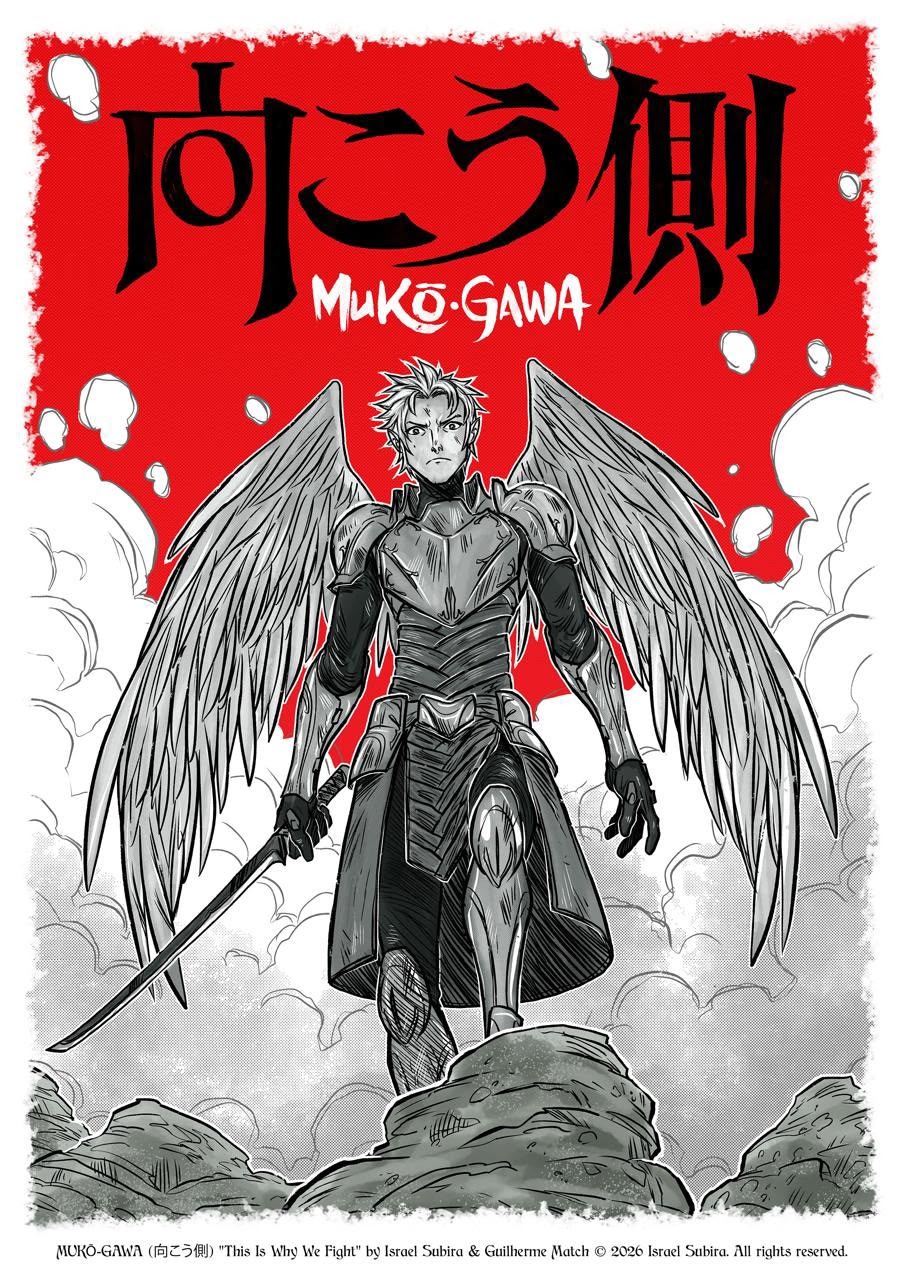
Yomikiri // 1 December 2026
The manga's yomikiri (pilot) arrives 1 December 2026.
Leave your email and we will let you know when sales open in your region. After that, news about the work. One click to leave.
Editions, pricing and shipping are handled by the retailer for each region. Dates shown are current publisher schedule and may change.